
 by MustBTV
A Structured Assessment of Causation, Evidence, and Competing Explanations
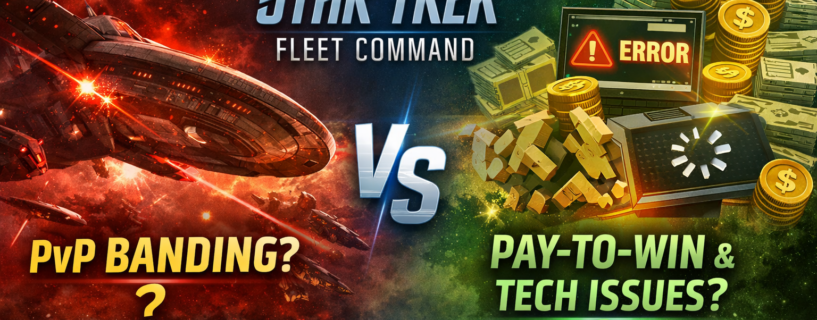
Bottom Line Up Front: After reviewing player complaints, issue tracking, and the broader condition of the game, I do not believe PvP banding is the primary driver of player disengagement in Star Trek Fleet Command.
The stronger explanation is the overall state of the game:
- technical instability
- broken or unreliable features
- monetization pressure
- whale-driven imbalance
- trust erosion and burnout
PvP frustration exists, but the evidence suggests it is usually part of a larger problem, not the central cause.
Short version: players are more credibly being driven away by game-state problems than by PvP banding.
Thesis
The stronger explanation for player frustration and disengagement in Star Trek Fleet Command is not PvP banding. It is the broader condition of the game itself: technical instability, broken or unreliable systems, monetization pressure, feature-execution failures, trust erosion, and accumulated player fatigue. The evidence collected here points consistently in that direction, while the claim that PvP banding is driving players away remains largely anecdotal, weakly evidenced, and logically incomplete.
I. Introduction
There is a recurring argument in the STFC community that PvP banding, or broader PvP exposure across power gaps, is a major force driving players away from the game. The theory is usually framed as a fairness argument, often dressed up as a smaller-player protection argument. The claim is emotionally intuitive, because unfair fights are memorable, resources lost in PvP are painful, and players naturally personalize conflict more than they personalize lag, menu failures, or event scoring issues.
But emotional intuition is not the same thing as causal proof.
If the goal is to understand what is actually driving player dissatisfaction and disengagement, then the question is not whether PvP annoys some players. Of course it does. The real question is whether PvP banding is the primary driver of players leaving, compared with the game’s broader and more persistent problems.
The evidence collected here indicates that it is not.
II. Research Question
What is the more credible primary driver of player disengagement in STFC:
- PvP banding and engagement unfairness, or
- Game-state problems, including instability, monetization pressure, unreliable systems, and long-term burnout?
That is the central question. Everything else in this paper serves that comparison.
III. The Opposing Claim
The opposing argument can be stated plainly:
PvP banding is driving players away because higher-level or stronger players can attack weaker players, creating an unfair environment that harms retention.
Sometimes this is phrased in narrower terms:
- “A level 71 should not be able to hit a 47.”
- “The banding is not protective enough.”
- “Smaller players are being driven out by unfair PvP exposure.”
- “Banding needs to be tightened to save newer or lower players.”
At first glance, these claims sound plausible because they describe a real source of frustration. But that is not enough. To establish a serious argument about retention, the theory must prove more than discomfort. It must prove causation.
IV. The Standard of Proof
For the PvP banding theory to hold as the primary explanation for player disengagement, it must establish four things.
1. Causation
It must show that PvP banding itself causes players to quit or disengage, rather than merely frustrating some players while larger problems do the actual damage.
2. Evidence of Scale
It must show that this problem is broad enough to materially affect the player base, not just be a common complaint among a visible subset.
3. Consistency with the Strongest Available Evidence
It must align with the most reliable evidence available, including issue logs, feature corrections, and player review patterns.
4. Internal Logical Consistency
It must survive scrutiny against the actual design and social environment of STFC, including RoE, shielding, protected cargo, monetization, raiding, and governance.
At present, the PvP banding claim does not satisfy that burden.
V. The Stronger Thesis: Game State Is the Real Driver
The more credible explanation is that player frustration and disengagement are being driven by the state of the game itself. Specifically:
- recurring lag and performance problems
- login and availability issues
- event scoring, payout, and store failures
- broken or unreliable features
- content and cadence trust problems
- aggressive monetization and whale advantage
- progression systems that increasingly feel like obligation rather than entertainment
These problems affect every aspect of the player experience. They are broader than PvP, harder to work around, and more destructive to trust.
A player can tolerate losing a fight.
A player is far less likely to tolerate not being able to trust the game.
VI. Evidence Category One: Operational Instability
This is one of the strongest parts of the case because it is not based on theory. It is based on repeated issue tracking.
The known-issues material provided shows a recurring pattern of live operational failures beginning at least in July 2025, including lag, login issues, scoring failures, payout failures, store problems, refinery problems, event failures, and repeated retrieval or responsiveness issues.
A. These are core-loop failures
These are not edge-case annoyances. These failures strike at the player’s ability to:
- enter the game
- complete events
- score correctly
- claim rewards
- trust stores and system outputs
- interact normally with gameplay loops
B. These failures are systemic, not isolated
A single bug does not prove a broken game. A repeated pattern across systems does. Lag, login, reward, scoring, and function failures across multiple game systems is exactly what a player experiences as “the game doesn’t work right anymore.”
C. Why this matters more than PvP
PvP banding affects who can hit whom.
Operational instability affects whether the game can be trusted to work at all.
That distinction is critical. One is a contest rule. The other is a playability problem.
VII. Evidence Category Two: Trust and Feature-Execution Failure
The Outposts material is especially useful because it shows a more subtle but deeper problem: trust.
In the official text from Solo Outposts: The Road Ahead, Scopely acknowledges that some prior initiatives “missed on timing, clarity, or follow through,” that players had concerns about uncertain cadence and whether content would return, and that “trust is earned by action.” That language is extremely revealing. It shows the problem is not simply bugs. It is that players have been conditioned to doubt whether the game’s systems and cadence promises will remain reliable.
That supports a much stronger churn theory than PvP banding.
A. Why trust matters
Players stay in long-term live-service games when they believe:
- their time investment is respected
- content returns when promised
- systems function as described
- their effort translates into stable value
When players stop believing those things, frustration becomes cynicism. Cynicism becomes disengagement.
B. Why this hits retention directly
A player who distrusts cadence, reward structures, or access rules is less likely to:
- buy in emotionally
- plan long-term progression
- trust future announcements
- feel the game is worth the time
That is a much more powerful retention factor than whether banding is too wide or too narrow.
VIII. Evidence Category Three: Player Review Patterns
This section helps because it is not just about design theory. It brings in player voice.
Google Play review source is treated canonically as the source for all review-based analysis. Wherever review-derived analysis appears, it should trace back to the Play Store listing below, with the extracted review samples treated as the dataset used for coding.
Google Play Store – Star Trek Fleet Command
https://play.google.com/store/apps/details?id=com.scopely.startrek
A. Why the review data matters
Reviews are imperfect. They are self-selected, emotional, and noisy. But they are still useful when analyzed as patterns rather than treated as isolated testimonials.
They help answer a very important question:
What are players actually talking about when they are dissatisfied?
B. Review Patterns by Rating Tier
1. The 1-star pattern
From the 1-star review sample provided, the dominant themes were:
- Technical issues: 42 of 162 reviews, about 25.9%
- PvP-related complaints: 2 of 162 reviews, about 1.2%
- Pay-to-win / monetization: 1 of 162 reviews, about 0.6%
These counts came from the extracted review sample and are supported by repeated examples in the dataset, including complaints about lag, crashes, bugs, login failures, and general system instability.
This pattern is important because the 1-star tier represents players at or near the point of disengagement, and in this dataset, PvP complaints are nearly absent while technical issues dominate.
2. The 2-star pattern
From the 2-star review sample provided, the dominant themes were:
- Pay-to-win / monetization: 77 of 94 reviews, about 81.9%
- PvP-related complaints: 36 of 94 reviews, about 38.3%
- Technical issues: 34 of 94 reviews, about 36.2%
These counts came from the extracted review sample and are supported by repeated examples in the dataset, including complaints about expensive progression, whale advantage, instability, crashes, and support failures.
3. Combined interpretation
Taken together, these two review tiers show a clear shift in player sentiment as frustration increases toward disengagement.
- In the 2-star tier (frustration phase), players most frequently complain about monetization pressure and progression imbalance, with PvP appearing as a contributing factor.
- In the 1-star tier (exit behavior), complaints shift heavily toward technical instability and system reliability, while PvP-related complaints become nearly nonexistent.
This distinction is critical. PvP appears more often when players are still engaged but frustrated, whereas technical failures dominate when players reach the point of leaving or rating the game at the lowest level.
If PvP banding were a primary driver of player disengagement, it would be expected to appear prominently in 1-star reviews. In this dataset, it does not.
Instead, the strongest signals at the point of disengagement are:
- lag and performance issues
- crashes and instability
- bugs and system failures
This supports the broader conclusion that game-state issues are a more credible driver of player disengagement than PvP banding.
C. What that pattern means
This pattern is extremely important.
It tells us that when players are frustrated but not yet in full rage-quit mode, their dominant complaint is not PvP by itself. It is monetization pressure. PvP appears, but often as a downstream expression of monetization imbalance. In other words, many players are not saying:
“PvP exists, therefore I quit.”
They are saying something closer to:
“PvP is miserable because the whales are too far ahead, the power imbalance is absurd, and progression is locked behind spending.”
That is a different claim.
D. Why this weakens the PvP-banding theory
If PvP banding were the root cause, PvP would dominate the complaint landscape. Instead, it shows up as one part of a larger structure of frustration dominated by monetization and supported by ongoing technical issues.
So even where PvP appears, it is often not the cause of the cause. It is the arena where a different cause, usually monetization imbalance, is felt most sharply.
IX. The Review Evidence Does Not Support PvP as the Central Driver
This is where the argument should become explicit.
The review pattern does not support the theory that PvP banding is the primary driver of disengagement.
Instead, the review pattern supports this:
- Monetization dominates dissatisfaction
- Technical instability remains a major complaint
- PvP appears as a secondary or hybrid complaint
- PvP complaints are often inseparable from whale advantage and progression imbalance
That means the opposing theory overstates PvP’s explanatory power.
PvP is real.
PvP frustration is real.
But the evidence does not show PvP banding is doing the heaviest explanatory work.
X. Structural Weakness in the Opposing Theory
A. It confuses a visible symptom with a root cause
PvP losses are visible. A player remembers being hit. They remember being raided. They remember the alliance tag and the ship name.
But root causes are not always the most visible frustrations. A player can remember the fight while not noticing that the deeper reason the fight felt impossible was:
- monetization imbalance
- broken progression
- tech instability
- poor support outcomes
- poor protective system reliability
This is a classic misattribution problem. The most visible pain point gets blamed for frustrations that actually originate deeper in the system.
B. It substitutes anecdote for causal proof
The pro-banding case usually offers:
- examples of unfair matchups
- stories of smaller players being bullied
- statements about what “should” be fair
- hypothetical claims about retention
What it does not provide is:
- retention data showing banding causes exit
- survey evidence tying departures primarily to banding
- comparative evidence showing banding outweighs monetization or tech instability
- consistent official evidence elevating banding above broader system failures
Without that, the theory remains more rhetorical than analytical.
XI. RoE and the Intended Conflict Environment
The RoE reference matters here because it grounds the discussion in STFC’s intended environment.
The RoE source shows that conflict is not an accident in this game. RoE is player-created and player-enforced, not a built-in peace system. It exists to regulate conflict, not remove it. Warships and OPC interactions are part of the conflict ecosystem, not deviations from it.
This matters because it undercuts a major hidden assumption in the opposing theory.
The game is not designed around broad insulation from conflict. It is designed around managed conflict.
That does not mean all PvP is healthy. It does mean that arguments treating PvP exposure itself as inherently contrary to the game’s structure are on weak footing.
XII. The “Protect Smaller Players” Argument Is Incomplete
A. Existing protection systems already exist
The game already includes:
- shields
- protected cargo distinctions
- server-level RoE norms
- diplomatic enforcement frameworks
That means the system is already supposed to include layers of player protection. If those protections are failing, the explanation is not automatically “banding is the problem.” It may just as easily be:
- governance failure
- enforcement inconsistency
- monetization imbalance overpowering protections
- system unreliability undermining normal safeguards
B. Banding is not equivalent to protection
Banding only addresses engagement range. It does not address:
- lag
- crashes
- login failures
- reward bugs
- support failures
- monetization pressure
- event access breakdowns
So even if one argues for tighter banding, that still does not establish it as the primary retention lever.
C. The argument ignores trade-offs
Tighter interaction rules can reduce certain forms of pain, but they may also reduce the flow of opportunity through conflict economies, raids, and resource redistribution.
That means the protection argument is incomplete unless it also accounts for what is lost.
XIII. Governance Contradiction
This is one of the most effective logical pressure points.
If the same larger players arguing that smaller players need more protection are also among the most influential players in RoE culture, diplomacy, and enforcement, then one of two things must be true:
1. RoE enforcement works
If so, widespread predatory abuse should already be constrained through governance.
2. RoE enforcement does not work
If so, the problem is governance failure, not proof that PvP banding is the primary cause of churn.
That is a serious contradiction. The argument cannot simultaneously claim:
- “We have meaningful player-enforced conflict governance”
- and
- “The problem is so widespread that only systemic banding changes can save players”
If governance matters, then governance must be part of the explanation. If governance does not matter, then the social conflict framework of the server is weaker than its defenders claim.
Either way, the simple “banding is the problem” narrative breaks down.
XIV. Economic Weakness in the Protection Theory
Smaller players are not only harmed by broader conflict systems. They can also benefit from them. When larger players crack larger bases, smaller players can sometimes participate in the resulting raid environment and gain access to resources or opportunities they otherwise would not generate on the same timeline.
That does not prove that all broad conflict exposure is good. It does prove the protection theory is incomplete.
If the theory says:
“Broader interaction only hurts smaller players”
then it is missing the conflict-driven redistribution side of the game’s economy.
Since the RoE framework supports the idea that resource-taking and raiding are legitimate, expected parts of the environment, that redistribution logic is relevant.
A theory that ignores both the risks and opportunities of conflict-based redistribution is analytically weak.
XV. Stronger Alternative Explanation
The evidence supports a much stronger alternative explanation:
Players disengage because the game becomes unstable, unreliable, expensive, bloated, and exhausting, and PvP frustration often appears as a downstream expression of those broader failures rather than the primary cause.
This explanation fits the evidence better for several reasons.
A. It explains the issue logs
Known issues show repeated system failures across live gameplay.
B. It explains the review patterns
The review data shows monetization dominating frustration and technical issues remaining persistent, with PvP usually layered on top rather than acting alone.
C. It explains the trust problem
The Outposts material shows that feature cadence, reliability, and trust had to be directly addressed.
D. It explains why players burn out
A game can survive difficult combat. It struggles to survive when players feel:
- their time is wasted
- the system is unreliable
- the spending pressure never stops
- support is ineffective
- content keeps expanding while stability lags behind
That explanation is much more consistent with the evidence than the narrower banding theory.
XVI. Final Synthesis
Once the evidence is separated into categories, the picture becomes very clear.
What is strongly supported
- The game has repeated operational failures.
- Players repeatedly complain about monetization and whale advantage.
- Players repeatedly complain about instability, bugs, crashes, and support failures.
- Trust and cadence breakdowns were serious enough to require corrective messaging.
- The game is built around managed conflict, not conflict avoidance.
What is not strongly supported
- Any causal proof that PvP banding is the primary driver of disengagement
- Any evidence showing banding outweighs monetization, instability, or trust failure as a churn factor
- Any robust retention data centering banding as the root issue
What the evidence therefore supports
The strongest conclusion available is not that PvP banding is driving players away.
The strongest conclusion is:
Player dissatisfaction and disengagement are more credibly driven by technical instability, unreliable systems, monetization pressure, feature-execution failures, trust erosion, and broader game-state fatigue than by PvP banding.
XVII. Conclusion
The claim that PvP banding is the primary driver of player disengagement in Star Trek Fleet Command is under-evidenced and analytically weak. It relies heavily on visible anecdotes, fairness language, and protection rhetoric, but it does not provide the causal proof necessary to establish banding as the central explanation.
By contrast, the evidence collected points in a consistent and much stronger direction:
- repeated known issues and operational instability
- repeated complaints about monetization and whale-driven imbalance
- repeated complaints about bugs, crashes, lag, and support failures
- an intended game framework based on managed conflict, not the absence of conflict
That makes overall game state, not PvP banding, the more credible primary explanation.
Or stated as directly as possible:
PvP may be where players feel the pain, but the evidence shows the deeper causes are instability, monetization, broken trust, and a game that too often fails to function smoothly.
Sources
- Google Play Store – Star Trek Fleet Command
https://play.google.com/store/apps/details?id=com.scopely.startrek - STFC VIP Server Known Issues Log
- STFC RoE Reference / PvP Target Guide
- User-Extracted Google Play 2-Star Review Dataset
- Solo Outposts: The Road Ahead (user-provided official text)
Closing
If the goal is to understand why players disengage, the evidence does not point first to PvP banding. It points to a game that has asked too much, delivered too inconsistently, and too often forced players to absorb the cost of instability, broken systems, aggressive monetization, and unreliable execution. PvP frustration exists, but it appears most often as a symptom layered on top of those larger failures, not as the central cause. The stronger, more evidence-based argument is not that banding is driving players away. It is that the condition of the game is.


